FieldForge
A connected field-service platform. From the first request to the work on site, approval, and payout.
Built for Buyers, dispatchers, technicians, and the teams coordinating on-site work.
Personal project · In development
- Ownership
- Product direction & implementation
- Timeline
- Aug 2026 — Present
- Project
- Independent
- Core stack
- NestJS, Next.js, React Native, MySQL
- Surfaces
- Web & mobile
01 / BUSINESS CONTEXT
The problem to solve.
A service job passes from a buyer to dispatch, a technician, an approver, and billing. Scope, assignment, site evidence, and payment need to remain connected across those handoffs.
RESPONSIBILITY
My contribution
I own the product direction and implementation: work-order rules, services, shared contracts, data models, buyer portal, and technician app.
Independent project in development, with product direction and hands-on implementation owned by me.
WHAT THE SOLUTION ENABLES
A developing workflow that connects job definition, technician assignment, field evidence, approval, and billing rules.
02 / WORKFLOW SUMMARY
Follow the business process.
- 01
Define & assign
Capture the job and accept one technician’s bid.
- 02
Execute
Check in, capture evidence, and queue actions through connectivity gaps.
- 03
Approve
Authorize completion against the work-order state and supporting records.
- 04
Settle
Model payment release and invoices after approval.
03 / SOLUTION DECISIONS
Business rules, made practical.
Several technicians may bid for the same job.
- Approach
- Lock the work order and accepted bid together.
- Why it matters
- Select one winner and keep assignment consistent.
Field work continues without a reliable connection.
- Approach
- Queue mobile actions with identifiers and replay them in order.
- Why it matters
- Preserve field progress while making retries safe.
A database update and message delivery can fail separately.
- Approach
- Store business events with the state change, then publish them through an outbox.
- Why it matters
- Keep a committed business change recoverable after a messaging failure.
DELIVERY CONTEXT
In development · August 2026–present. The public repository documents the implementation. Billing uses a deterministic local ledger provider for development and tests.
ABOUT THE EVIDENCE
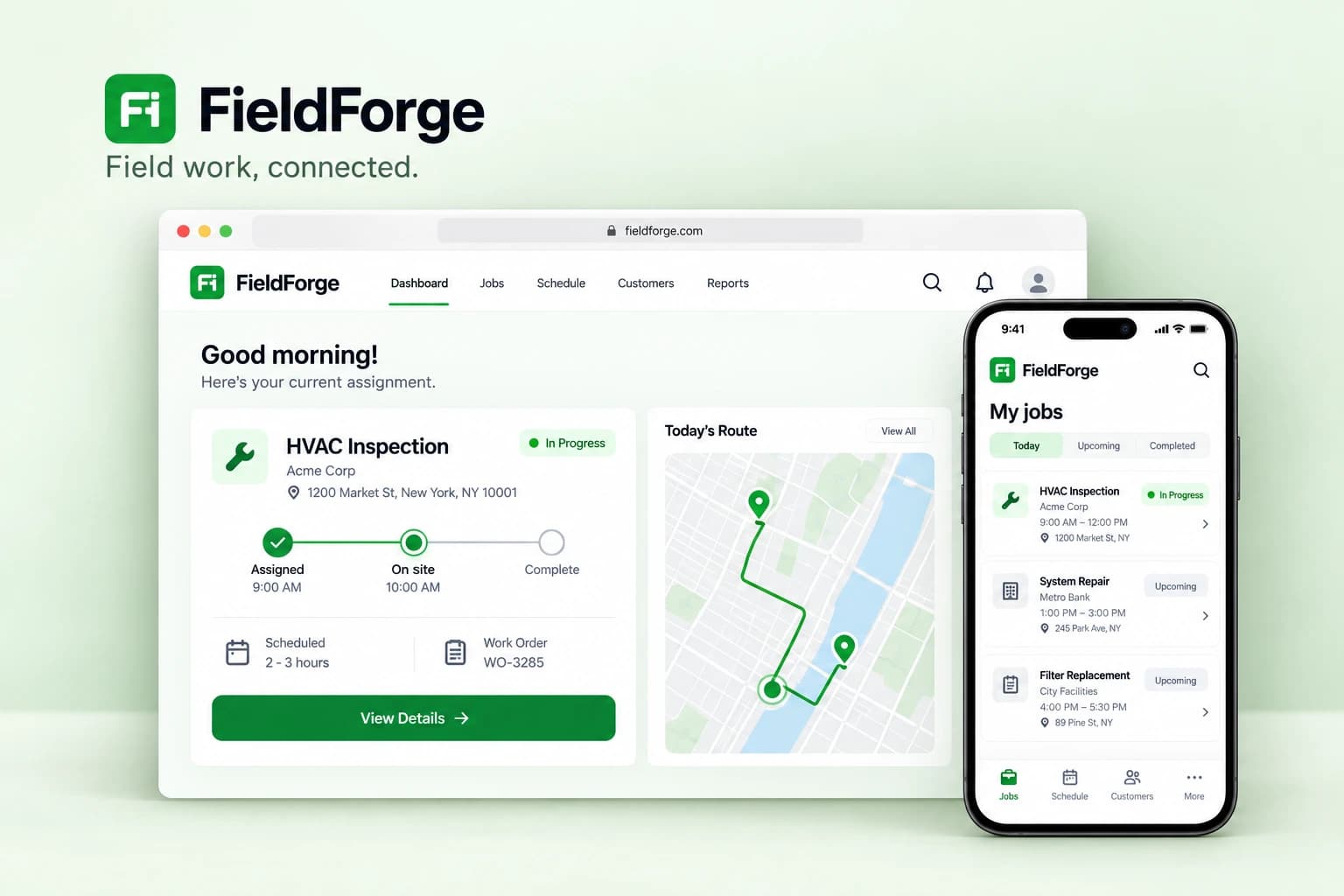
Website and mobile artwork illustrates the intended experience. It is concept presentation, not evidence of a production release. Kubernetes and Terraform are infrastructure exploration.
04Product experiences
One job. A connected journey.
Explore the website, the mobile app, and the workflow that connects them.
Plan & coordinate
Technician website
A browser workspace for finding work, managing assignments, and organizing the day.
- Job discovery, assignments, and scheduling
- Messages, shared files, and job context
- Earnings, credentials, and account preferences
One work-order lifecycle. These product views show the intended experience of the platform in development.
CONCEPT ARTWORK / TECHNICIAN WEBSITE
The working day, in one place.
Nine concept presentations of the intended technician experience. These designs illustrate a product in development, not a production release.
Scroll to explore. Select an image to preview
05Key capabilities
Built around the realities of field work
The core capabilities being developed, from choosing a technician to confirming the work.
Location-aware dispatch
Find technicians using proximity, qualifications, and job context.
Evidence of completion
Photos, signatures, and check-in records support work approval.
Work through connectivity gaps
Queue technician actions offline and replay them in order.
Approval-led billing
Model holds and payout release around the work-order lifecycle.
06Challenges & solutions
Making the handoffs reliable
Explore the decisions behind assignment, execution, payment, and recovery.
01One job, one assignment
Competing bids need a single, consistent winner.
Explore the approach
Dispatch uses Redis geospatial search to find technicians near the job location. Candidates are ranked with a deterministic score based on distance, rating, completed jobs, and certification matches.
Technicians can submit bids only for published work orders. Duplicate pending bids are blocked. Accepting a bid locks both the bid and work order before selecting the winner, rejecting competing bids, and assigning the technician.
That keeps the marketplace state clear: one accepted bid, one assigned technician, and one work order status.
02Rules at every step
An action must be valid for the person and the current job state.
Explore the approach
Work orders move through a controlled lifecycle: draft, published, assigned, en route, on site, completed, approved, paid, cancelled, or disputed. Each transition checks the current state, caller role, and ownership before updating the order.
Database transactions and row locks protect important changes. Publishing a work order, accepting a bid, assigning a technician, and marking a job paid all update the domain record, status history, and events together.
The technician app supports travel start, check-in within a 200-meter geofence, before and after photos, serial numbers, signatures, and job completion. Offline actions are queued locally with idempotency keys and replayed in order when the device reconnects.
03Safe payment retries
Repeated requests must not create repeated payouts.
Explore the approach
Billing is modeled around escrow-style holds. A buyer can lock funds for a work order, and funds can be released only after the work is approved by an authorized user.
The release path uses idempotency records, row locking, and a single escrow account per work order to prevent duplicate payouts. It records payout ledger entries, generates invoice data, and can refund unused escrow balance when the final payout is lower than the held amount.
Payment provider behavior sits behind an interface, with a deterministic ledger provider for local development and tests. That keeps billing rules testable without depending on a live provider.
04Recoverable events
A temporary messaging failure should not lose a business change.
Explore the approach
Work-order and billing services write domain events into an outbox inside the same transaction as the business change. A relay publishes those stored events to RabbitMQ after commit, so a broker failure does not erase the business event.
The outbox relay claims small batches with row locking, uses expiring leases and claim tokens for recovery, keeps events ordered per aggregate, applies publish timeouts, retries temporary failures with backoff, and marks malformed payloads as dead.
Consumers use Redis-backed event deduplication, keep correlation IDs, retry failed handlers a limited number of times, and route exhausted attempts to dead-letter queues.
07How it works
Shared rules behind every experience
The applications connect through an API gateway, domain services, and a shared event model.
Web & mobile
Next.js web portal
React Native / Expo app
Shared TypeScript contracts
Domain services
Gateway & authentication
Work orders & dispatch
Billing & notifications
Data & events
MySQL / Drizzle
Redis location & deduplication
RabbitMQ / transactional outbox
Explore technical decisions
FieldForge is organized as a Turborepo with NestJS services behind an API gateway, shared TypeScript contracts, MySQL tables, Redis for location and deduplication, RabbitMQ for events, a Next.js buyer portal, and a React Native mobile app.
Docker Compose supports local development. Kubernetes/Kustomize and Terraform definitions are included for infrastructure modeling.
The service boundaries follow the hard parts of the domain: work-order state, billing state, dispatch decisions, async events, and client workflows.
08Technologies
Implementation toolkit
- NestJS
- TypeScript
- MySQL
- Drizzle
- Redis
- RabbitMQ
- Next.js
- Redux Toolkit
- React Native
- Expo
- Turborepo
- Docker Compose
Next steps
Have a service workflow to connect?
Let’s turn the problem into a clear plan, a useful product, and a path to launch.